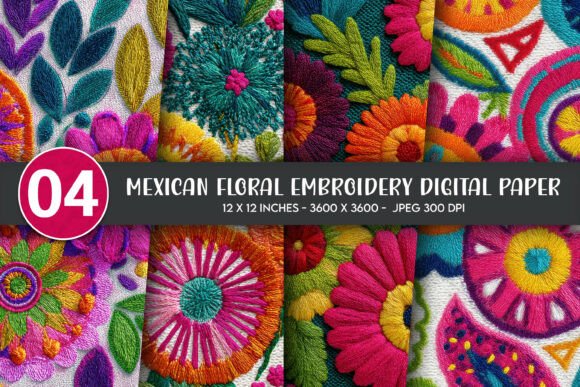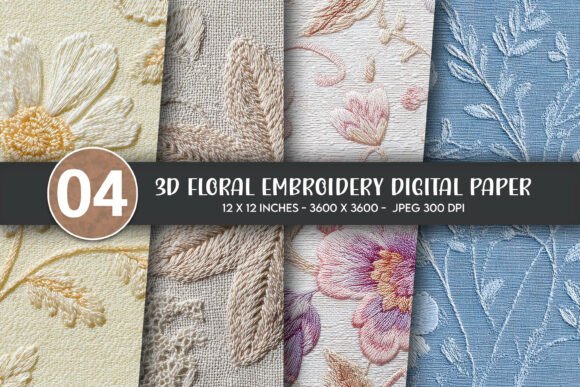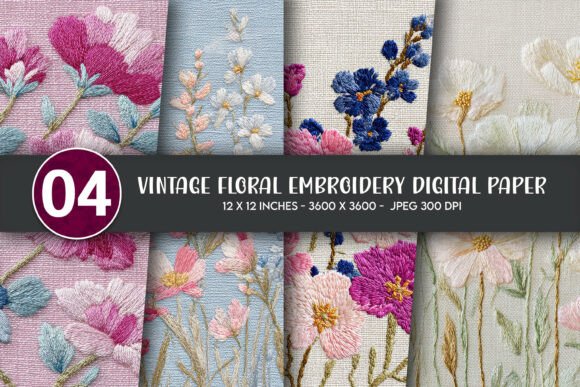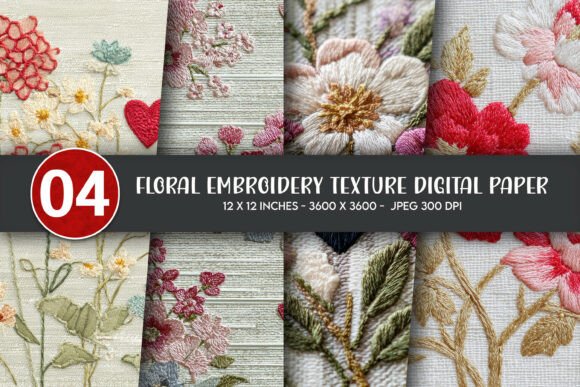
Mexican Embroidery Floral Digital Paper
A Vibrant, Handcrafted Mood—Before the Needle Even Moves
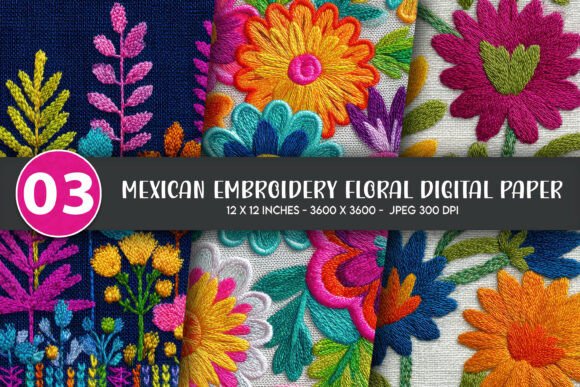
As an embroidery designer who’s stitched hundreds of custom orders—from boutique aprons to nursery wall hangings—I opened Mexican Embroidery Floral Digital Paper expecting bold color and folk-art soul. What I found was exactly that: a joyful, layered illustration brimming with stylized florals, swirling vines, and rhythmic symmetry. It doesn’t read as “clip art” or generic vector—it feels hand-drawn, with intentional imperfections in line weight and petal shape that translate beautifully into stitch. This isn’t just a graphic; it’s a design asset with embroidery personality baked in.
Fits Naturally Where Handmade Charm Matters Most
Mexican Embroidery Floral Digital Paper lands perfectly in categories where authenticity and cultural warmth elevate perceived value: kitchen towels for artisanal food brands, pillow covers for boho nurseries, tote bags for small-batch makers, and baby blanket corners for personalized gifts. Its Illustrations category makes sense—it’s not a machine embroidery design out of the box, but its high-resolution nature means it scales cleanly for digitizing or direct print use. As Graphics, it’s flexible: you can trace it for custom applique design, adapt it into a satin stitch border for sweatshirt embroidery, or use it as a printable mockup base for Etsy listings.
Real-World Stitching: What Holds Up (and What Needs Care)
I tested the floral motif across several real project types before committing to a client order. On a cotton tote bag? Excellent clarity—even at 4.5 inches wide, the inner vine details stayed legible with proper stabilizer. On a lightweight onesie? I scaled down to 3.2 inches and used tear-away + light cutaway stabilizer; the fill stitch areas held without puckering, but I avoided placing dense clusters over shoulder seams. For a curved cap front, I simplified one corner motif into a standalone bloom—small hoop sizes demand editing, and this design responds well to thoughtful cropping.
On dark fabric, contrast became critical. The original palette leans warm—ochres, deep reds, forest greens—so white or cream thread pops cleanly, but pastel threads faded visually. On stretchy fabric like jersey sweatshirts, I added a layer of adhesive stabilizer beneath the standard cutaway, and ran a slow, steady stitch speed to prevent distortion in the satin-stitched petals. No surprises there—but it’s worth noting that the design’s decorative density rewards attention to thread colors and stitch density. Overly tight fills on small elements can cause thread breakage on older machines; a quick check of tiny centers (like flower pistils) on scrap fabric saved me time later.
Where It Adds Quiet Value—Beyond the Stitch
This isn’t just about what goes on the hoop—it’s about what happens after. Mexican Embroidery Floral Digital Paper elevates handmade presentation. A kitchen towel with this motif stitched in variegated cotton thread reads as intentional, culturally grounded, and carefully curated—not mass-produced. That perception boosts buyer trust, especially among Etsy shoppers and craft fair buyers who pay premiums for storytelling through design. It also strengthens brand consistency: if your shop leans into earthy, artisanal aesthetics, this motif reinforces that voice across product types—pillow cover, greeting card, even a matching sticker sheet.
For giftability, it shines. A baby blanket corner with a single embroidered bloom from this set feels personal, celebratory, and heirloom-adjacent. Photographed against natural light and textured linen, it performs exceptionally well in product photography—no heavy retouching needed. Customers engage more when designs carry emotional resonance, and this one delivers: it hints at celebration, heritage, and care—all without words.
Practical Notes Before You Digitize or Print
- Always test on scrap fabric first—especially with textured weaves (like burlap tea towels) or blends (poly-cotton caps), where stitch density can behave unpredictably.
- Review thread color contrast on both light and dark fabric mockups. Some inner details rely on tonal variation—not just hue—so grayscale previews help.
- Confirm hoop size compatibility. Full motifs may exceed 5×7 hoops; smaller elements work cleanly in 4×4, but check spacing if planning multi-position repeats.
- Use appropriate stabilizer for your base: cutaway for knits, tear-away for stable wovens, and fusible + tear-away for lightweight linens.
- Inspect small details post-stitch. Tiny leaves or vine tips may need gentle repositioning with tweezers or a light press—especially on plush fabrics like terry cloth towels.
- Verify file details and licensing on the Creative Fabrica product page before selling finished products. Since this is listed under Illustrations and Graphics—not pre-digitized machine embroidery design—you’ll need to confirm commercial use rights for your specific application (e.g., embroidered patch vs. printed mug).
Final Thought: A Design That Earns Its Place
Mexican Embroidery Floral Digital Paper isn’t a “set-and-forget” embroidery file. It asks for thoughtful adaptation—and repays that effort generously. It works because it’s designed with intention, not automation. When translated into a custom apparel piece or a handmade gift, it carries warmth, rhythm, and quiet confidence. For embroidery designers building cohesive collections, Etsy sellers refining their visual language, or small studios sourcing reliable design assets, it’s a versatile, mood-rich foundation—not just filler. Just remember: honor its character in your choices—stabilizer, thread, scale, and surface—and it will honor your craftsmanship right back.