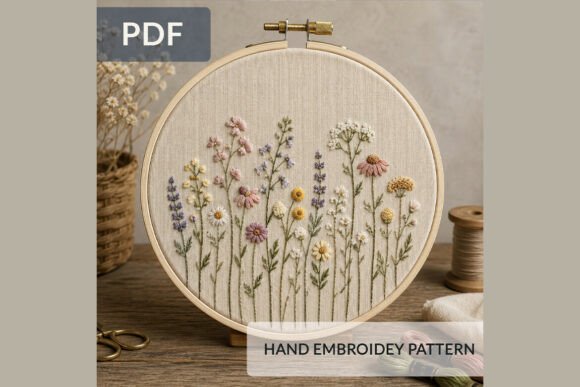
Wildflower Hand Embroidery Pattern PDF
As a designer who’s stitched, sold, and styled hundreds of embroidery patterns for small businesses and custom clients, I opened the Wildflower Hand Embroidery Pattern PDF expecting charm—and found something more: quiet intentionality. This isn’t just a floral silhouette tossed into a hoop; it’s a meadow rendered in stitchable rhythm—soft curves, breathing negative space, and botanical variety that feels gathered, not arranged. I tested it on a linen tea towel first, then scaled it for a baby onesie and a canvas tote—three very different real-world uses—and each time, the pattern held its voice without shouting.
A Measured Meadow, Not a Busy Bouquet
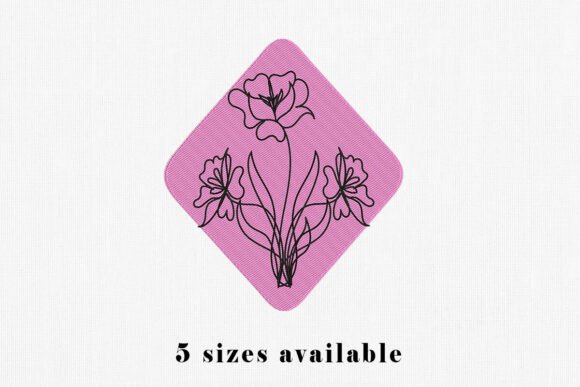
The Wildflower Hand Embroidery Pattern PDF leans into subtlety. No oversized blooms or tight clusters. Instead, you get daisies with open centers, slender stems with gentle bends, and tiny buds placed like afterthoughts—exactly how wildflowers behave. That looseness translates beautifully to handmade products: it reads as thoughtful, not fussy. On a sweatshirt cuff or apron pocket, it doesn’t compete with texture or wear—it complements it. For Etsy sellers building a cohesive brand around “quiet luxury” or “botanical simplicity,” this pattern quietly reinforces that aesthetic without needing a tagline.
Where It Shines (and Where It Asks for Care)
I used the Wildflower Hand Embroidery Pattern PDF to embroider a set of kitchen towels for a local boutique. The result? Customers paused mid-aisle—not because it was loud, but because it felt *handmade in the right way*: imperfectly balanced, gently asymmetrical, alive. That same quality works well on:
- Tote bags and canvas aprons — the scale holds up at 4–5 inches wide, and the open layout avoids stiffness
- Baby items — onesies, burp cloths, and crib mobiles benefit from its soft edges and low visual density
- Pillow covers and tea towels — the design breathes on natural fibers like linen and cotton duck
- Holiday or wedding gifts — especially for couples who prefer garden-party elegance over formal florals
But here’s where attention matters: the Wildflower Hand Embroidery Pattern PDF isn’t built for tight corners or dense coverage. Avoid placing it on curved surfaces like baseball caps unless you’re willing to adjust stem angles manually. On stretchy fabric—think lightweight knits for baby tees—stabilize generously, and consider simplifying one or two stems if thread tension pulls detail out of shape. And while it reads beautifully on light and medium fabrics, test contrast carefully on dark backgrounds: pale yellow or ivory thread may disappear without a subtle outline stitch.
Stitching Clarity Meets Commercial Sense
This is a hand embroidery pattern, not a machine embroidery design—but its clean line work makes it unusually adaptable. I traced it onto heat-transfer paper for a batch of embroidered patches (using simple running and satin stitches), and the shapes held definition even at 2.5 inches. That flexibility matters for craft businesses: one Wildflower Hand Embroidery Pattern PDF can become a patch, a tote bag motif, a nursery wall hanging, *and* a printable mockup for your Etsy listing—all without redrawing.
That said, don’t assume it’s “plug-and-play” for every surface. On thin fabrics like voile or rayon challis, back it with tear-away stabilizer *and* test stitch density—some inner petals read better with sparse fill than heavy satin. On textured weaves (burlap, heavy twill), simplify petal outlines to avoid lost detail. And if you’re offering personalized gifts—like monogrammed wildflower towels—leave at least ¾ inch of margin between name and stems. Crowding kills the meadow’s airiness.
What It Does for Your Brand—and Your Buyers
Customers don’t buy stitches. They buy feeling. The Wildflower Hand Embroidery Pattern PDF delivers calm, authenticity, and tactile warmth—qualities that boost perceived value in handmade product listings. On an Etsy page, it helps photos feel intentional, not generic. In a boutique, it supports quiet branding: no logos needed when the embroidery itself signals care and curation.
For creative entrepreneurs, it also builds trust. Because the pattern avoids over-engineered complexity, buyers sense honesty—not “more for the sake of more.” That translates to fewer returns, more repeat customers, and stronger word-of-mouth. One client told me her customers specifically asked for “that meadow towel again”—not by SKU, but by memory of how it *felt*.
Designer Notes You’ll Actually Use
Before cutting fabric or listing a finished product, do these five things:
- Test on scrap — especially if using textured or dark fabric. See how stems hold at your preferred thread weight.
- Check thread color contrast — try the same flower in ecru, sage, and charcoal on white linen. Which tells the story you want?
- Review stitch density — this pattern invites variation. A few lazy daisies in running stitch + one bold bloom in satin adds hierarchy without complication.
- Confirm hoop size fit — the full meadow fits comfortably in a 6-inch hoop, but smaller arrangements (a single stem + bud) work beautifully in 3–4 inches for patches or baby items.
- Verify licensing — since this is a Hand Embroidery Patterns digital file, confirm whether resale of finished embroidered items is permitted, and whether you may use it in digital product previews or printable mockups.
Also worth noting: while it’s labeled a “beginner tutorial,” its strength lies in its adaptability—not its simplicity. A seasoned designer can interpret the lines freely; a new stitcher won’t drown in detail. That dual accessibility is rare, and valuable.
Final Thought: It’s Not Just a Pattern—It’s a Mood Anchor
In a market flooded with bold lettering and maximalist motifs, the Wildflower Hand Embroidery Pattern PDF offers grounded elegance. It doesn’t demand attention—it earns it, slowly, through repetition and restraint. Whether you’re stitching a holiday gift, prepping a craft fair booth, or building a signature line of embroidered apparel, this pattern doesn’t shout “look at me.” It whispers, “this was made with care”—and in handmade commerce, that whisper often travels the farthest.