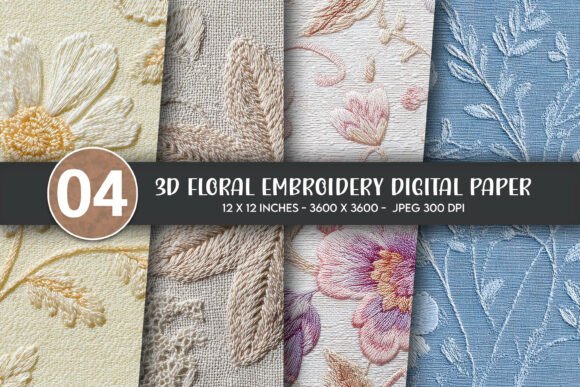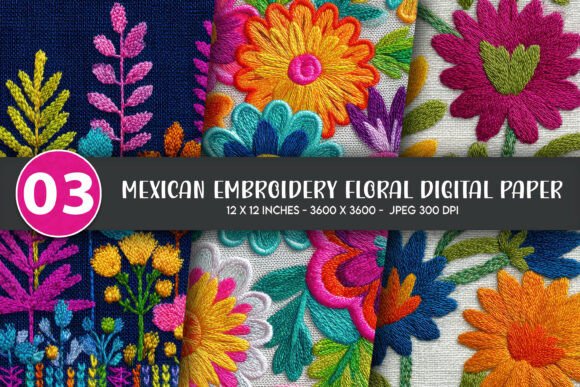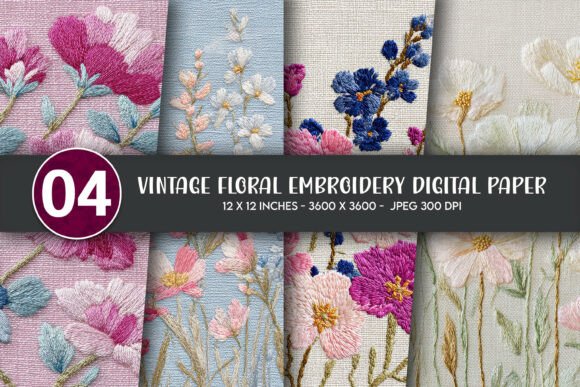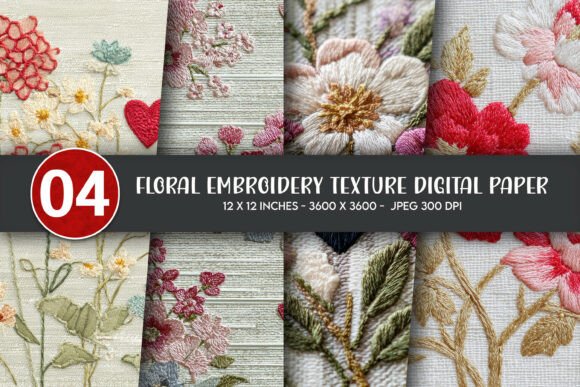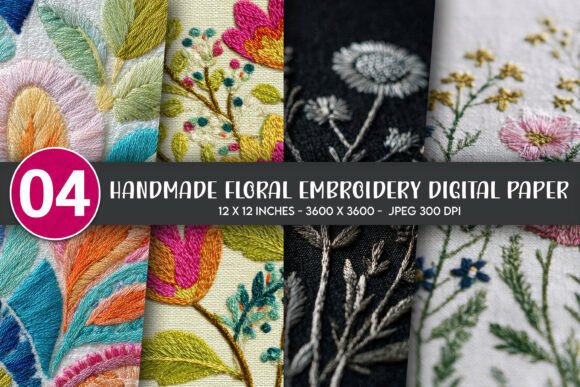
Handmade Floral Embroidery Digital Paper
A Designer’s Real-World Review for Small Business Merchandise
As an embroidery designer who’s developed hundreds of machine embroidery designs for cafés, florists, boutiques, bakeries, and handmade brands, I approach every new digital embroidery file with two questions: Will it translate cleanly to fabric? and Will it strengthen my client’s brand—not just decorate it? When I first saw Handmade Floral Embroidery Digital Paper, the title alone signaled something intentional: “handmade” suggests warmth and authenticity; “floral” implies approachability and organic charm; “digital paper” hints at versatility across print and stitch. It’s not just another clipart-style illustration—it’s positioned as a Graphics asset built for real business use, from embroidered patches to tote bag designs.
First Impression: Friendly, Handcrafted, and Professionally Refined
The phrase Handmade Floral Embroidery Digital Paper immediately evokes a visual personality—soft but structured, detailed but not fussy, elegant without being stiff. It feels like the kind of design that would sit comfortably on a ceramic mug in a local florist’s shop, stitched onto the chest of a barista’s apron, or embroidered as a subtle sleeve accent on a boutique owner’s work shirt. It doesn’t shout—it invites. That’s critical for small businesses building trust through consistency and care. Unlike overly ornate or hyper-realistic floral illustrations, this one reads as intentionally designed for translation: balanced negative space, clear petal and stem separation, and implied stitch-friendly contours.
Where It Shines in Commercial Embroidery Projects
In my studio, Handmade Floral Embroidery Digital Paper works exceptionally well for:
- Embroidered patches—ideal for iron-on or sew-on branding on tote bags, denim jackets, or staff uniforms. Its floral motif reads clearly even at 2.5"–3" width when digitized with appropriate underlay and satin fill density.
- Apron embroidery—a natural fit for bakeries, florists, and craft studios. The design’s organic flow complements the curved drape of cotton or linen aprons without competing with functional pockets or straps.
- Cap embroidery—when scaled to front-panel size (typically 2"–2.25" tall), it maintains legibility and charm, especially with clean thread color pairings (e.g., sage green + cream on navy twill).
- Tote bag design—as a centered chest logo or side accent, it elevates unbranded canvas or jute without overwhelming the material’s texture.
- Product packaging accents—think stitched labels on handmade soap boxes, tea tins, or candle sleeves. As a digital embroidery file, it bridges print and stitch seamlessly.
- Etsy branding & customer gifts—small-batch makers love using it for limited-run embroidered gift tags, greeting cards, or mini patch giveaways that reinforce their handmade product story.
Use With Intention: Where Caution Is Needed
Even beautiful Illustrations can falter in embroidery if applied without context. Here’s where I advise extra attention with Handmade Floral Embroidery Digital Paper:
- Small patch sizes under 2": Fine stems or tightly clustered petals may collapse or blur. Always test-stitch at intended size before bulk production.
- Curved surfaces like cap fronts or mugs: Digitization must account for stretch and distortion—don’t assume the flat graphic file will auto-adapt.
- Dark or textured fabrics: High-resolut detail means little if thread contrast is weak. Test black thread on charcoal linen or metallic thread on burlap before finalizing.
- Frequent-wash items (e.g., staff uniforms): Confirm stitch density supports durability—overly dense fills on delicate florals can crack or pucker over time.
- Items requiring tight registration (like product labels): Ensure spacing between elements allows for clean cutting and stitching alignment—no floating stamens or disconnected leaves.
How It Strengthens Brand Identity—Beyond Decoration
This isn’t just about prettiness. When a local café uses Handmade Floral Embroidery Digital Paper on barista aprons and as a printed motif on their takeaway cup sleeve, customers subconsciously register cohesion. That consistency builds recognition. When a pet brand pairs it with custom collar tags or embroidered bandanas, the floral motif softens the “pet care” message—making expertise feel nurturing, not clinical. For Etsy sellers, it signals craftsmanship without needing explanatory text. And crucially, because it’s rooted in a handmade aesthetic, it reassures buyers they’re supporting human-scale creation—not mass production. That emotional resonance directly lifts perceived product value and repeat engagement.
Practical Notes Every Embroidery Designer Should Apply
Before launching into production, here’s my checklist for Handmade Floral Embroidery Digital Paper:
- Test it in black and white first—does the silhouette hold? Are outlines distinct enough for your target fabric?
- Check how it scales down: open it at 1.75" width and assess clarity of key features (center bloom, leaf junctions, stem continuity).
- Review thread color contrast—especially against common uniform colors (navy, black, khaki, white).
- Inspect spacing between elements—tight clusters need breathing room for clean satin stitches and proper stabilizer support.
- Confirm hoop size compatibility—some floral motifs require larger hoops for smooth tension; don’t force it into a 4"x4" if the design spans 5".
- Test on real fabric—not just screen mockups. A linen blend behaves differently than polyester twill, and stabilizer choice changes everything.
- Create a printable mockup for client approval—show it stitched on an apron, cap, and tote side-by-side to demonstrate versatility.
- Compare it beside your other design assets—does it harmonize with your current logo, typography, and brand palette?
- Confirm commercial licensing—since this is marketed for t-shirts, mugs, tote bags, and more, verify usage rights cover your specific business model (e.g., resale, wholesale, digital distribution).
Remember: Handmade Floral Embroidery Digital Paper is more than a Graphics download—it’s a brand-building tool. Used thoughtfully, it becomes part of your client’s visual language, not just their merchandise lineup. Whether you’re digitizing it for a local florist’s staff caps or adapting it for a craft studio’s limited-edition embroidered patch collection, its strength lies in how gracefully it moves between digital flexibility and tactile authenticity. That’s rare—and valuable.